
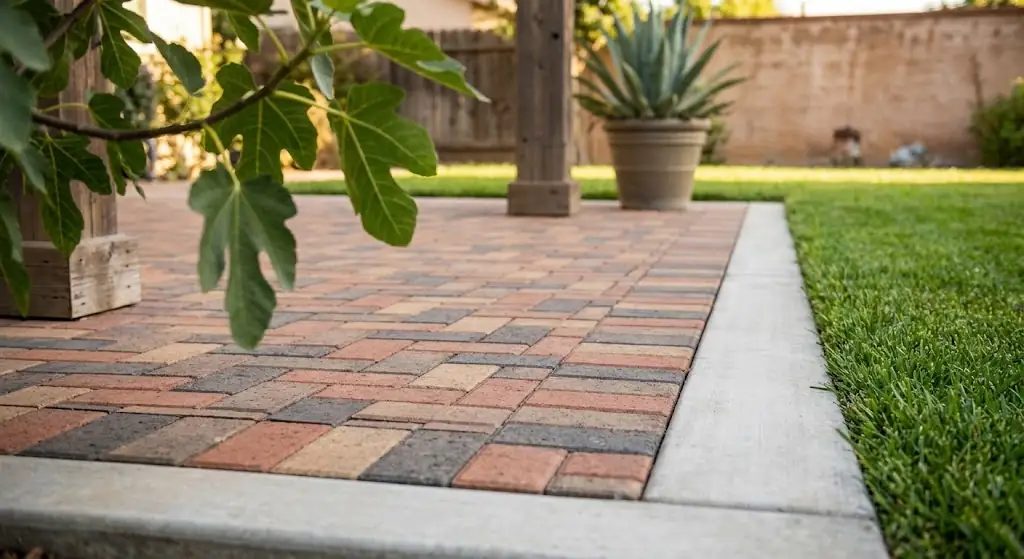
When the weather warms up in the Central Valley, your backyard should be the best room in your house. Whether you want a quiet place to drink your morning coffee, a space to host weekend barbecues, or a comfortable lounge area next to the lawn, it all starts with the ground under your feet.
At Modesto Pavers, we build custom paver patios designed to handle real life. We don’t believe in shortcuts or quick fixes. We believe in building hardscapes that look great on day one and still look great a decade later.
Living in Modesto, CA, we are lucky to get long, sunny summers and mild winters. That means you get to use your outdoor space nearly year-round. But our local climate and soil conditions also mean you have to be careful about what materials you put in your backyard.
The Honest Truth About Concrete in Modesto, CA
If you are looking to install a new patio, you are probably weighing the differences between poured concrete and interlocking pavers. It’s important to look at this critically. Concrete is often the default choice for builders because it is cheap and fast to pour. But if you’ve lived in the area for any amount of time, you already know the problem with concrete: it cracks.
The soil in our region is heavily clay-based. Clay acts like a sponge. During our wet winter months, the ground absorbs water, expands, and pushes upward. During our dry, triple-digit summers, that same soil dries out, shrinks, and pulls away.
When you pour a large, rigid slab of concrete on top of soil that constantly expands and contracts, the concrete is forced to bend. Since concrete can’t bend, it snaps. Builders try to control this by cutting lines into the concrete, hoping it cracks neatly inside those lines, but nature rarely cooperates.
Interlocking pavers solve this problem entirely. Because a paver patio is made up of hundreds of individual stones sitting on a flexible bed of sand and crushed rock, the patio can actually move with the earth. If the ground swells, the patio subtly flexes. You don’t get ugly, jagged cracks running through the middle of your seating area. From a long-term investment standpoint, pavers simply make more sense for our local soil.
How We Build Your Paver Patio (The Right Way)
A patio is only as good as the foundation sitting underneath it. You can buy the most expensive paving stones in the world, but if the dirt underneath them isn’t prepped correctly, your patio will sink, shift, and hold puddles of water.
Here is exactly how Modesto Pavers builds a patio that lasts:
1. Proper Excavation We don’t just scrape the top of the grass off. We dig down deep enough to remove the soft topsoil and organic matter. We need to reach solid ground before we start building up.
2. Compacting the Subgrade Once we reach the right depth, we use heavy plate compactors to tamp down the native soil. We also carefully grade the dirt so that water flows away from your home’s foundation.
3. Laying the Base Rock This is the most critical step that cheap contractors skip. We bring in tons of crushed base rock, spread it evenly, and compact it until it is rock-solid. This thick layer of aggregate is what gives your patio its strength and prevents the stones from sinking when you put heavy furniture on them.
4. The Bedding Sand On top of the hard base rock, we screed a smooth, consistent layer of bedding sand. This gives the pavers a uniform surface to sit on and locks the bottom of the stones into place.
5. Placing the Pavers We lay the paving stones by hand in your chosen pattern. Whether it’s a complex herringbone pattern or a clean, modern running bond, we ensure the lines are straight and the cuts around the edges are precise.
6. Edge Restraints Without a border, the pavers on the outside edges of your patio would eventually slide outward into your lawn. We install strong, hidden edge restraints around the entire perimeter, spiked deeply into the base rock to hold everything tight.
7. Joint Sand and Final Compaction Finally, we sweep specialized jointing sand over the patio to fill the small gaps between the stones. We run a compactor over the surface one last time. This vibrations settle the sand, locking the stones together so tightly that they act as a unified surface.
Finding the Right Look for Your Yard
Your home is unique, and your patio shouldn’t look like a generic copy-and-paste job. One of the biggest advantages of working with pavers is the massive variety of design options.
We can help you navigate the choices and find a style that actually matches your home’s architecture.
- Color Choices: When choosing colors for a patio in Modesto, CA, you have to think about the summer sun. Very dark pavers look incredibly modern, but they will absorb a lot of heat in July and August. If your patio is in direct sunlight, we often recommend lighter earth tones, grays, or tans to keep the surface temperature comfortable for bare feet.
- Texture and Shape: Do you have an older, traditional home? Tumbled pavers with slightly rounded edges offer a classic, cobblestone look that fits perfectly. Do you have a newer, modern build? Large-format pavers with sharp, clean lines and smooth surfaces create a sleek, contemporary feel.
- Custom Borders: We can easily use a contrasting color or shape to create a “picture frame” border around the edge of your patio. This defines the space and makes the whole project look polished and intentional.
Easy Maintenance and Simple Repairs
We like to be upfront with our customers: no outdoor surface is completely maintenance-free. Dirt will blow in, and leaves will fall. However, paver patios are incredibly easy to take care of.
For day-to-day cleaning, all you need is a broom or a leaf blower. If there is a spill from a barbecue, a quick rinse with a garden hose and some mild dish soap is usually enough to clean it up.
But the biggest advantage of a paver patio is how easy it is to repair. Let’s say a tree root grows underneath your patio five years from now and pushes a section upward. If you had concrete, you would have to rent a jackhammer, destroy the slab, and pour a patch that will never perfectly match the old concrete.
With pavers, we simply pull up the affected stones, cut out the tree root, fix the base material, and put the exact same stones right back into place. It’s a seamless fix that saves you time, money, and frustration.
Ready to Upgrade Your Backyard?
You shouldn’t have to spend your summers staring at a cracked concrete slab or a patch of dead grass. You deserve an outdoor space that looks beautiful, functions perfectly, and adds real value to your property.
Let’s talk about your yard, your ideas, and what it will take to bring them to life.
Ready to get started? Reach out to us today to schedule an estimate on our Contact Us page.