
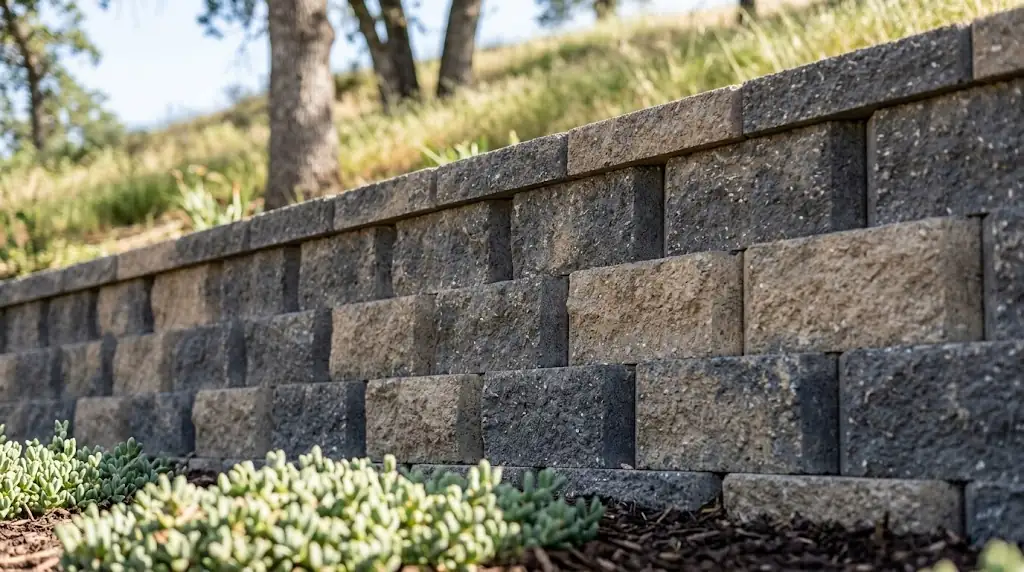
Most hardscape projects—like patios and driveways—are about creating a beautiful surface on top of flat ground. Retaining walls are entirely different. Building a retaining wall is a fight against gravity, soil mechanics, and water.
If you have a sloping property, you already know the frustration of dealing with unusable land. Hillsides are difficult to mow, impossible to place furniture on, and prone to washing away during heavy winter rains. A retaining wall solves these problems by cutting into the slope and holding the earth back, instantly turning a steep, useless hill into flat, functional square footage.
However, because retaining walls have to hold back tens of thousands of pounds of dirt, they cannot be built like a standard garden border. At Modesto Pavers, we don’t just stack blocks on top of the grass. We build heavily engineered segmental retaining walls designed to structurally hold the earth in place for decades. If you are looking to reclaim your yard in Modesto, CA, it is critical that you understand exactly what makes a wall stand strong—and why so many of them fail.
Why Most Retaining Walls Fail in Modesto, CA
If you drive around any older neighborhood, you will inevitably see retaining walls that are leaning forward, bowing in the middle, or completely collapsing. When a wall fails, it is almost never the fault of the blocks themselves. It is the result of a builder who didn’t understand the physics of soil and water.
Let’s look critically at the most common materials and methods used by cheap contractors and DIYers, and why they ultimately fail in our Central Valley climate.
The most common mistake is using wooden railroad ties or landscaping timbers. Wood and wet dirt are a terrible combination. No matter how heavily treated the wood is, placing it in direct contact with damp soil guarantees that it will eventually succumb to rot and termite damage. Once the wood softens, the wall gives way.
The second major failure point is a complete lack of drainage. The soil in our region is heavily clay-based. When clay gets wet during our winter storms, it acts like a sponge, absorbing massive amounts of water. Water is incredibly heavy—weighing over 62 pounds per cubic foot. When the dirt behind a wall gets saturated, it creates what engineers call “hydrostatic pressure.”
If a wall is built without a way for that water to escape, the trapped water acts like a hydraulic press, pushing outward against the back of the blocks. Eventually, the hydrostatic pressure overcomes the weight of the wall, pushing the blocks forward until the entire structure blows out.
The Science of Holding Back the Earth
To build a retaining wall that won’t bow or lean, you have to engineer it from the ground up to handle both the weight of the soil and the pressure of the water. We use high-strength, interlocking segmental retaining wall (SRW) blocks, but the real strength of our walls lies in what you don’t see once the project is finished.
Here is how we build a wall that actually lasts:
1. A Subterranean Foundation You cannot build a strong wall on top of soft topsoil. We excavate a deep trench and fill it with heavy, crushed aggregate rock. We compact this rock with heavy machinery to create an unyielding foundation. We then bury the entire first course (the bottom row) of blocks completely underground. This “embedment” locks the base of the wall into the earth so the bottom can never kick out.
2. The Setback (Batter) A structural retaining wall is never built perfectly plumb (straight up and down). As we stack each row of blocks, we step them slightly backward into the hill. This angle is called the “batter.” By leaning the wall backward into the earth, we force gravity to work for us, using the sheer weight of the blocks to push back against the soil.
3. Geogrid Reinforcement For walls taller than a few feet, simply stacking heavy blocks isn’t enough. We have to tie the wall directly into the hillside. We do this using a material called geogrid—an incredibly strong, synthetic mesh. We lay the geogrid between the layers of blocks and run it several feet back into the hillside. When we compact the dirt on top of the geogrid, the weight of the dirt itself actually anchors the wall in place. The soil and the wall become one unified, immoveable structure.
Solving the Water Problem with Proper Drainage
Because hydrostatic pressure is the number one killer of retaining walls, water management is the most critical part of our installation process. We never backfill a retaining wall with the native clay dirt we just dug out of the hill.
Instead, we create a dedicated drainage zone immediately behind the wall. We fill the space behind the blocks with 12 to 18 inches of clean, crushed gravel. Because water travels the path of least resistance, any rain that hits the soil will immediately drop straight down through this highly porous gravel column rather than pushing against the back of the blocks.
At the very bottom of this gravel column, sitting behind the buried base course, we install a perforated PVC drain pipe. This pipe captures all the descending water and safely channels it away from the wall, venting it out to the sides of the property or into a dedicated drainage basin. By completely removing the hydrostatic pressure, we guarantee the structural integrity of the wall.
Beyond Function: Creating Beautiful Multi-Level Landscapes
While the engineering behind our walls is highly technical, the final result is stunning. Retaining walls are not just utilitarian structures; they are powerful design elements that completely redefine the topography of your yard.
By terracing a steep, unusable hill with multiple, shorter retaining walls, we can create tiered, flat levels. Suddenly, a dangerous slope becomes a beautiful series of elevated garden beds, flat play areas for children, or private seating spaces.
We can also build freestanding seating walls around your new paver patio or fire pit. These double-sided walls are usually 18 to 24 inches tall and are capped with smooth, flat stones. They visually define the edge of your patio space while providing built-in, permanent seating for your guests during summer barbecues.
Because our retaining wall blocks are manufactured by the same companies that make our paving stones, we can perfectly match the colors and textures of your wall to your driveway, walkway, or patio, creating a cohesive, professionally designed aesthetic across your entire property.
Stop Fighting Gravity and Start Building Smart
A failing retaining wall is a hazard to your property, your landscaping, and your peace of mind. If you are dealing with an unusable slope, severe soil erosion, or an old wooden wall that is rotting away, you need a permanent, engineered solution.
Don’t trust your property line to cheap landscaping blocks and poor drainage. Invest in a structural wall that will stand straight, drain perfectly, and look beautiful for the lifetime of your home.
Let’s take a look at your property’s elevation and design a wall system that works. Reach out to us today to schedule a site evaluation through our Contact Us page.