
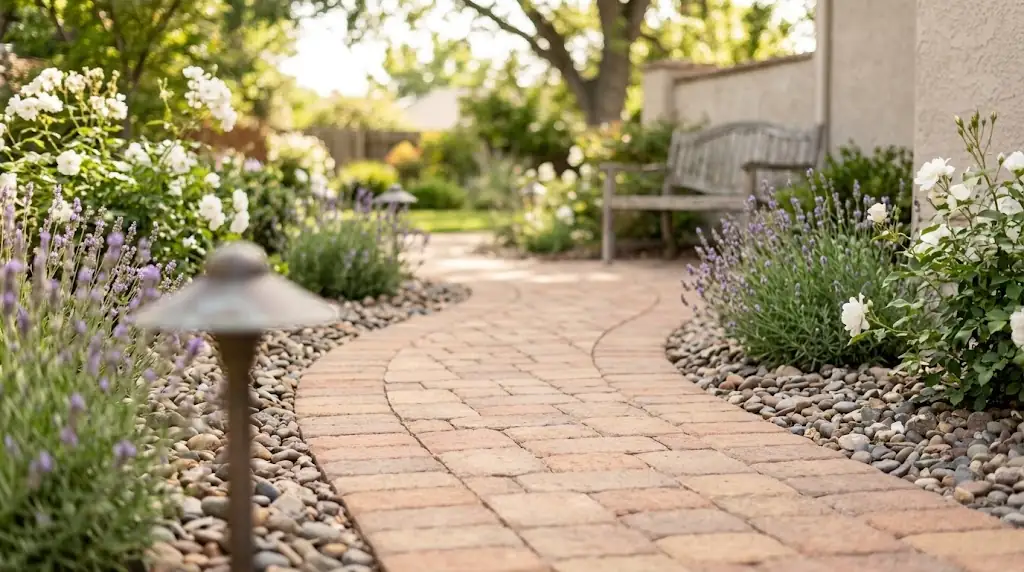
A home is made up of separate rooms connected by hallways. Your property operates the exact same way. The driveway, the front door, the side gates, the backyard patio, and the garden are all distinct spaces. Walkways are the outdoor hallways that tie your entire property together.
Most homeowners don’t give much thought to their paths until there is a functional problem—like stepping in mud to take the trash out, tracking dirt into the kitchen, or tripping over a cracked piece of concrete in the dark.
At Modesto Pavers, we believe your pathways should be more than just an afterthought. We build custom interlocking paver walkways that provide safe, stable, and visually striking navigation throughout your yard. If you are looking to upgrade the curb appeal and functionality of your property in Modesto, CA, a properly engineered paver walkway is one of the smartest, most practical investments you can make.
The Flaws of Concrete and Loose Stepping Stones
When looking critically at how to build a path, you have to evaluate the standard alternatives. In our area, the two most common solutions are poured concrete and loose stepping stones. Both come with significant drawbacks when exposed to real-world conditions.
Let’s look at standard concrete first. Builders often pour narrow, three-foot-wide concrete paths along the sides of houses to provide basic access to air conditioning units or side gates. Because these concrete strips are usually pinned between the house’s foundation and a fence, they are highly susceptible to shifting soil. The clay soil in Modesto, CA acts like a sponge, expanding when wet during winter and shrinking when baked dry in the summer. This constant, uneven movement puts immense pressure on a rigid slab of concrete, inevitably causing it to crack, heave, and become an eyesore.
Loose stepping stones, or flagstones simply dropped into the grass or dirt, are even worse. While they might look charming in a magazine, they fail from a practical standpoint. Without a properly excavated and compacted rock base underneath them, stepping stones slowly sink into the mud during our wet months. They become uneven, wobbly, and create a massive trip hazard. Furthermore, trying to maneuver a lawnmower or weed whacker around irregularly spaced stones is a frustrating, time-consuming chore that most homeowners quickly grow to hate.
Why Interlocking Pavers Make Sense for Walkways
Pavers solve the structural issues of poured concrete and the stability issues of loose stones. An interlocking paver system is built on a deeply compacted base of crushed aggregate rock. This thick, engineered base provides a stable, unyielding foundation that prevents the surface stones from sinking, regardless of how soggy the surrounding ground gets.
Because the surface is made of individual stones separated by specialized jointing sand, the entire walkway remains flexible. If a nearby tree root pushes up, or the underlying soil expands, the walkway can subtly flex with the earth rather than snapping in half.
Furthermore, pavers provide a continuous, uniform surface. You get the premium, custom aesthetic of stone, but with a perfectly flat surface that is safe to walk on, easy to roll a heavy trash can over, and simple to navigate for elderly guests or children.
Designing the Right Flow: Straight Lines vs. Curves
Building a walkway isn’t just about laying stones on the ground; it is about thoughtfully designing how people move through your space. We approach walkway design by looking critically at the primary function of the path.
- Utilitarian Paths: If we are building a path down the narrow side of your house to access utility meters, or a direct path from the back door to a detached garage, the goal is pure efficiency. For these paths, we generally recommend straight lines and a clean, simple layout. You want the fastest, safest, most direct route to get from point A to point B when you are carrying heavy groceries or dragging a recycling bin in the rain.
- Experiential Paths: On the other hand, if we are designing a path leading through your front yard to the main entryway, or a walkway winding through a lush backyard garden, we want to intentionally slow the eye down. Sweeping curves feel far more organic and inviting. A curved walkway subtly guides the person walking, forcing them to take in the landscaping, the architecture of the home, and the outdoor environment, making the simple act of walking to the front door part of the experience.
Dimensions, Proportions, and Edge Restraints
One of the most common mistakes DIYers and cheap contractors make is building walkways far too narrow. A standard builder-grade sidewalk is usually three feet wide, which awkwardly forces two people to walk single-file.
If you are building a primary walkway leading up to your front door, it needs to feel welcoming and grand. We strongly recommend building front entry walkways at least four to five feet wide. This allows two people to comfortably walk side-by-side, instantly elevating the look of the property. For secondary paths, like hidden garden trails or side-yard access, a three-foot width is perfectly acceptable.
Regardless of the width, a walkway is essentially a ribbon of stone cutting through grass, mulch, or dirt. Without proper engineering, the stones on the outer edges will naturally want to push outward and separate over time as people walk on them. To prevent this, every walkway Modesto Pavers installs includes a heavy-duty edge restraint system.
We install these hidden barriers along the entire perimeter, driving long steel spikes deep into the compacted base rock below. This locks the border stones tightly in place. The edge restraints sit just below the soil line, so once the grass grows back or the mulch is laid, you never see the plastic or metal edges—you only see crisp, clean lines of paving stones that will never spread or drift into your lawn.
Choosing the Right Patterns and Borders
The aesthetic versatility of interlocking pavers means we can tailor the walkway to match the style of your home perfectly.
For walkways, the “running bond” pattern is incredibly popular and highly effective. This is the classic brickwork pattern where the joints are staggered. When you run a running bond pattern parallel to the direction of the path, the long lines naturally draw the eye forward, creating an optical illusion that makes a short walkway feel longer and more elegant.
We also heavily utilize contrasting borders on our walkway designs. By using a darker stone to “picture frame” the edges of the path against a lighter interior stone, we create a distinct visual boundary. This not only looks fantastic, adding a layer of custom detail, but it also creates a clear visual cue for where the path ends and the landscaping begins. This contrast is a subtle but highly effective safety feature, especially in low-light conditions.
A Safer, Smarter Investment for Your Home
Your property is too valuable to be diminished by cracked concrete paths, muddy side yards, or sunken stepping stones. A properly built interlocking paver walkway offers a non-slip, structurally sound surface that permanently enhances both the safety and the beauty of your yard.
Don’t wait for someone to trip on an uneven stone or settle for tracking mud into your house every winter. It is time to build a foundation that will actually last.
Let’s discuss your property layout and design a custom walkway system that makes sense for your home and your lifestyle. Reach out to us today to get the conversation started by visiting our Contact Us page.